
In Auvers-sur-Oise, images of Vincent van Gogh’s paintings are juxtaposed against the scenes that inspired them—a powerful sight that travelers can experience on an optional Path of Van Gogh tour during The Seine: Paris to Normandy.
In Auvers-sur-Oise, images of Vincent van Gogh’s paintings are juxtaposed against the scenes that inspired them—a powerful sight that travelers can experience on an optional Path of Van Gogh tour during The Seine: Paris to Normandy.
Auvers-sur-Oise was to be the ideal place for Vincent van Gogh to let his artistic spirit run wild.
A French village of less than 2,000, an artist-friendly enclave full of provincial charm and limitless inspiration. Vibrantly hued fields peeking out from behind quaint, thatched-roof houses, while clusters of stone buildings are separated only by narrow, winding streets.
This setting was ideal for the archetypal names of the Impressionist and Post-Impressionist movements, which made Auvers flush with talent, all of whom could enjoy the pleasure of creating art in the country and then transporting their new works the 17 miles southwest to Paris with relative ease.
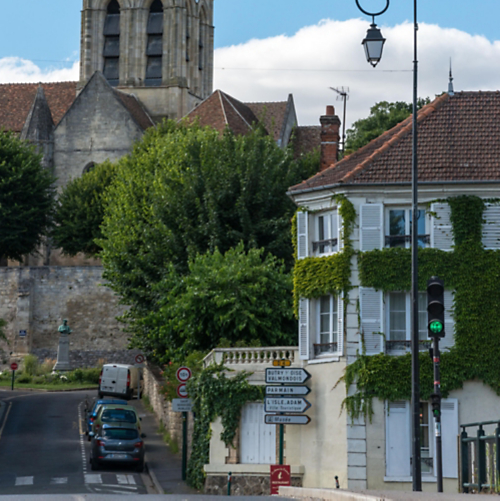
The creative inspiration van Gogh found in Auvers-sur-Oise could not overcome his personal demons.
In fact, walking through Auvers today offers the opportunity to feel a museum gallery come to life. Renoir’s 1901 Landscape Auvers-sur-Oise emerges from a windswept pasture, while homes still maintain the feel captured in Pissarro’s 1873 Village Street, Auvers-sur-Oise.
This hotbed of potential was quickly noted when van Gogh—only 37 years old—arrived in May of 1890. Shortly thereafter, he wrote to Theo, his younger brother and closest confidante: "There is a lot to draw here."
Draw—and paint—he did. Experts now attribute more than 70 van Gogh paintings to the roughly 70 days he spent in Auvers, among them some of his most highly regarded pieces. It was here he created the acclaimed 1890 L’église d’Auvers-sur-Oise, vue du chevet (The Church in Auvers-sur-Oise, View from the Chevet), and his highly scrutinized Wheat Harvest series.
From a professional standpoint, this village provides the setting for one of the brightest spots in van Gogh’s life—resulting in works that continue to dazzle audiences and serve as insights into his artistic mind and talents.
But from a personal perspective, it is in Auvers where emotional and physical turmoil with which van Gogh struggled for much of his life returned in earnest. It’s here—specifically, in a wheat field featured prominently in several of his final paintings—that most historians believe van Gogh shot himself in the chest on July 26, 1890. It was an injury from which he would die, two days later, in his bed.
As the location for such darkness and light in the life of van Gogh, Auvers and its history offer a remarkable glimpse into the life of this Dutch painter, which is all the more incredible given the short time he actually called the village home. And the resulting works of art add to the story—particularly one piece that most succinctly reflects the talent and struggle at play there. Today, it’s known as the highest-priced piece of art ever sold at public auction (for $82.5 million, in 1990). But beyond the price tag, the piece casts light on the key reason van Gogh found himself in Auvers at a critical crossroads of his life.
The portrait is of the man van Gogh sought out in May of 1890, in a desperate attempt to find peace in his life … the same man who would be at his side as he lay dying two months later.
It’s called Portrait of Dr. Gachet.
A troubled life
After so many experts have devoted time to studying and dissecting van Gogh’s life, it seems like an exercise in oversimplification to describe him as a troubled soul. And yet that’s one of the few things on which those experts can agree. To be sure, van Gogh had issues. It’s simply not clear precisely what was at play.
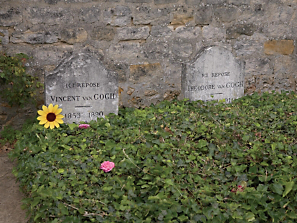
Van Gogh is buried in Auvers-sur-Oise next to his beloved brother.
A heavy smoker and drinker, van Gogh suffered gastrointestinal issues, headaches, and fevers. In one letter to his brother, Theo suggested Vincent refrain from painting (he was too fond of tasting his materials and possibly poisoning himself). The painter reported "attacks," episodes after which he could recall few details. Medical professionals who treated him suspected epilepsy, as did the artist. Over the years since van Gogh’s death, others have diagnosed possible schizophrenia, bipolar disorder, and more—a cornucopia of possible conditions that may have played a part in his life … and his death.
Whatever the root of those struggles was—or whatever combination may have been at play—the road to Auvers-sur-Oise was paved with struggle and sorrow. And given that van Gogh went on to produce more than 2,000 works during his lifetime, it can be difficult to wrap one’s mind around the fact that the artist, born in the Netherlands on March 30, 1853, began only to establish himself as a focused artist at the age of 30.
The results of those final seven years, however, made up for the years spent discovering his path. After moving to France and focusing his efforts, van Gogh began to develop a trademark use of color and shape. His technique featured rich layers of paint and an undulating brushstroke that gave his pieces a dreamy, borderline-abstract quality. At times, he used this tool lightly—the 1888 Café Terrace at Night reflects the linear structure of its subject. But at other times, he embraced this fluidity whole-heartedly, as is the case in his iconic 1889 The Starry Night, a masterpiece of swirling stars in an inky sky. As he learned to master this craft in portraits or still life scenes (such as Van Gogh’s Chair and Still Life: Vase with Twelve Sunflowers, both completed in 1888) the work developed a singular, identifiable style reflecting his Post-Impressionistic approach.
And when van Gogh worked, he worked—incredible bursts of output at a staggering volume. But when the artistic mind was racing, so came the struggles. Each of van Gogh’s three most prolific spans of creativity was accompanied by increasingly severe episodes of physical and emotional struggle.
Today, these phases can be most easily identified in a geographical sense. The Arles period (1888-1889) yielded gems like the 1888 Night Café and the emergence of van Gogh’s love of bold color. And yet it is also forever linked with December 23, 1888, when van Gogh cut off his left ear and brought it to a brothel.
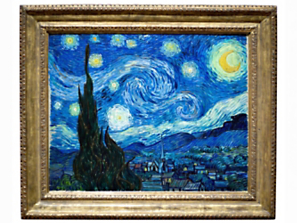
The troubled artist painted The Starry Night while committed to an asylum.
The subsequent year (1889-1890) in Saint-Remy, at the Saint Paul-de-Mausole asylum, van Gogh produced The Starry Night as he started making a turn toward the positive—until a crippling two-month series of what his doctors described as "attacks" left him incapable of writing or reading letters between February and April 1890.
As Vincent struggled to recover, the idea of Auvers developed. In a letter to Theo during the previous autumn, fellow artist Camille Pissarro suggested Dr. Paul Gachet, citing him as "someone in Auvers, who’s a doctor and does painting in his free moments." Auvers was an artist-friendly village with an artist-friendly physician. And not only was Gachet friendly with many of the local talents, he was also known for his skill in treating nervous disorders.
By May, Vincent had jumped upon the idea, asking his brother to reach out to Gachet, post-haste. Gachet agreed to the request. And thus the Auvers phase began.
The portrait … of the artist?
Despite the strong recommendations, the Gachet that van Gogh met upon his arrival in Auvers could have seemed a curious choice given Vincent’s fragile state. There were strong similarities between the two men, to be sure, right down to the bright red hair atop their heads. But there was something else as well. Something all too familiar for van Gogh. "This doctor’s experience must keep him balanced himself," Vincent wrote Theo, "while combatting the nervous ailment from which it seems to me he’s certainly suffering at least as seriously as I am."
Regardless of whether the doctor-patient relationship was the best one for van Gogh—debates are still being waged on the subject—the two formed a quick friendship. Van Gogh came to refer to the bond as brotherhood. "So much do we resemble each other physically and mentally," van Gogh said of Gachet.
Stressors, however, were setting in. By July, Vincent was in a state of agitation. Health issues were plaguing Theo’s son (and Vincent’s namesake). Vincent was also worried financial strains were looming in his brother’s life. As the regular recipient of money and art supplies, it’s logical to believe Vincent may have begun to fear he was being a burden. And—as was a trend throughout his life—stress, physical ailment, and emotional struggles traveled hand-in-hand.
Letters written during this time began to reflect a defeated spirit. And among the paintings flowing from his hands onto canvas came two versions of what would become known as Portrait of Dr. Gachet.
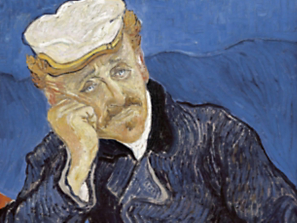
A portrait of the doctor … or the artist himself?
The doctor sits at a table, his right arm propped up to cradle his cheek. Red hair peeks out around the doctor’s temples, just beneath the brim of an off-white cap, a worn, troubled face on display below it. Historians have noted that that face is thinner than in real life. In fact, it more closely resembles van Gogh’s features than his subject’s. As such, it can be—and widely is—seen as much a self-portrait as a portrait of Gachet.
Looking at the furrowed brow and defeated body language of the subject slumped at the table, this portrait—perhaps even a thinly veiled, final self-portrait of Vincent van Gogh—represents the short time he spent in Auvers: beautiful and deeply heartbreaking, both at the same time.
Follow in the Path of Van Gogh on an optional tour in Auvers-sur-Oise during Grand Circle’s The Seine: Paris to Normandy River Cruise Tour River Cruise Tour.
Reborn from the Ashes: Notre Dame de Paris
A Grand Circle Program Director reflects on the reopening of Notre Dame Cathedral.
Valentine's Day: A French Love Story Gone Wrong
From fiery feuds to candlelit romance: how French Valentine's Day celebrations evolved from their explosive past into today's elegant expressions of love.
The Olympic Evolution: A Century-Long Sprint Toward Equality
When Paris welcomed the world back in 2024, it achieved what was unimaginable in 1900: perfect gender parity among athletes.
Get The Inside Scoop On...
Like what you see here? Receive weekly updates right in your inbox.
inside-scoopArticles In This Edition
