Imagine you’re in Paris, and it’s the summer of 1900. Gas lamps flicker against the twilight. Horses’ hooves clod across cobblestone streets, while the first motorized carriages are sputtering to life. The air buzzes with the excitement of the new century. The Eiffel Tower, barely a decade old, pierces the skyline—a steel sentinel watching over the "City of Light."
Beneath the tower's watchful gaze, the second modern Olympic Games is officially in motion—and twenty-two women are about to shatter centuries of tradition. In defiance of Victorian sensibilities and social conventions, they step onto the Olympic stage, their corseted figures and floor-length skirts a stark contrast to their male counterparts.
Pioneers in petticoats
Those first 22 female Olympians likely couldn't have imagined the impact of their participation. Competing in just five events—tennis, sailing, croquet, equestrian, and golf—they made up a mere 2.2% of the 997 athletes.
Among them stood Charlotte "Chattie" Cooper Sterry, a British tennis player who would become the first female Olympic champion in history. Despite competing in ankle-length skirts and long-sleeved shirts, Cooper dominated the tennis courts, winning both singles and mixed doubles gold medals. Her victory marked the beginning of a new era in sports, though few realized it at the time.
20 years later, women's swimming and diving would join the Olympic program—marking a significant stride toward equality in sports. However, when women were finally permitted to compete in track and field at the 1928 Amsterdam Games, controversy erupted after the 800-meter race. Several exhausted runners collapsed at the finish line—a common occurrence in any challenging race—but officials used this as justification to ban women from running distances over 200 meters for the next three decades.
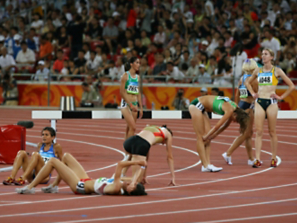
After winning the 2008 Olympic heptathlon in Beijing, Natalia Dobrynska and her competitors rested on the track—a cause for controversy in 1928.
Medical experts of the time claimed that distance running could damage women's reproductive health—a myth that would persist well into the 20th century. It wouldn't be until 1960 that women could again compete in the 800 meters, and the women's marathon wasn't added until 1984, when American Joan Benoit made history by winning the inaugural event in Los Angeles.
A revolution in motion
Fortunately, the 1970s and '80s marked a period of accelerated change. The introduction of Title IX in the United States in 1972 helped create a pipeline of female athletic talent, while social movements worldwide pushed for greater equality in all aspects of life. New sports joined the Olympic program: basketball in 1976, hockey in 1980, cycling in 1984, and tennis (which had been removed) returned in 1988.
By the 1996 Atlanta Games, women comprised 34% of competitors. For the first time, it seemed possible that true equality wasn't just a distant dream. The International Olympic Committee began actively pushing for change, setting participation targets and encouraging sports federations to expand opportunities for women. This era saw the rise of iconic athletes like Jackie Joyner-Kersee, whose versatility in track and field events helped shatter stereotypes about women's athletic capabilities.
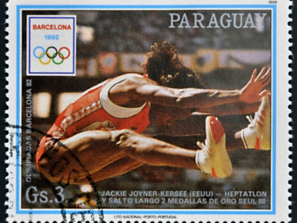
Jackie Joyner-Kersee on a 1989 stamp, printed in Paraguay.
The 21st century brought even more dramatic progress. The 2012 London Games marked the first time every participating nation sent at least one female athlete, including traditionally conservative countries like Saudi Arabia and Qatar. By the 2020 Tokyo Olympics (held in 2021), women made up 48% of athletes and competed in every sport on the program. New mixed-gender events were introduced—including mixed relays in swimming and track, mixed team events in judo, and mixed doubles in table tennis.
The next leap forward
When Paris welcomed the world back in 2024, it achieved what was unimaginable in 1900: perfect gender parity among athletes. For the first time in Olympic history, women and men competed in equal numbers across all sports. The symmetry of this achievement—occurring in the same city where women first joined the Olympic movement—provided a powerful bookend to more than a century of progress.
This milestone—124 years in the making—isn’t only marked on the playing field, either. As of 2023, women hold 41% of positions in the International Olympic Committee—double the percentage from 2013—and lead numerous national Olympic committees and sports federations.
Experience the historic atmosphere of Paris on Grand Circle’s The Seine: Paris to Normandy River Cruise.