
The National Institute for Blind Youth, where Louis Braille developed his eponymous touch-reading system at age 15, now resides on Boulevard des Invalides in Paris—which you can visit during Grand Circle’s The Seine: Paris to Normandy River Cruise.
Answer: What world-changing invention was created by a teenager using the very instrument that had caused his life-altering accident as a toddler?
Answer: The Braille reading system.
In 1824, within the walls of the National Institute for Blind Youth in Paris, a teenage student accomplished what seasoned educators and inventors had failed to achieve. Louis Braille, just 15 years old, created a tactile reading and writing system that would transform literacy for blind people worldwide. Remarkably, he developed this revolutionary system using an awl—the very type of tool that had accidentally blinded him as a three-year-old child.
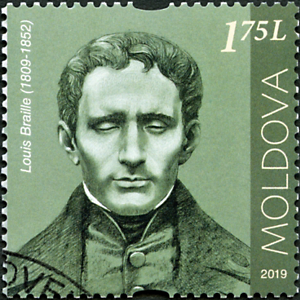
Postage stamps depicting Louis Braille have been issued all over the world.
The story begins in the small French village of Coupvray, where young Louis lived with his parents, Monique and Simon-René Braille. His father worked as a harness and saddle maker, and the family workshop was filled with sharp tools of the trade. One fateful day in 1812, three-year-old Louis picked up an awl (used for punching holes in leather) from his father's workbench. While playing with the pointed tool, he accidentally struck his eye. The injury led to infection in both eyes, and by age five, Louis was completely blind.
Rather than limiting their son's future, Louis's parents were determined to provide him with an education. They enrolled him in the village school, where he learned by listening and quickly proved himself an exceptional student. His academic promise earned him a scholarship to the National Institute for Blind Youth in Paris when he was just 10 years old.
At the institute, students faced a challenging educational system. They learned to read by tracing enormous, raised letters—a slow, cumbersome process that made writing nearly impossible. The books were massive, expensive to produce, and contained very limited information. A single book could weigh several pounds and contain only a few sentences per page.
The breakthrough came in 1821 when Charles Barbier, a French Army officer, visited the school. Barbier introduced his "night writing" system—a code of 12 raised dots arranged in various patterns that soldiers could use to communicate silently in darkness. While Barbier had originally developed this system for military purposes, he believed it could help people with visual impairments.
The students, including 12-year-old Louis Braille, immediately recognized both the potential and the problems with Barbier's system. The 12-dot configuration was too large to read with a single fingertip, making it slow and difficult to decipher. But Louis saw something others might have missed: the foundation for something better.
Over the next three years, Louis worked tirelessly to refine and simplify Barbier's concept. He reduced the 12-dot cell to just six dots, arranged in two columns of three. This elegant configuration could be felt with a single touch of the fingertip. Using different combinations of these six dots, he created 64 unique symbols representing letters, numbers, punctuation marks, and even musical notation.
The irony wasn't lost on anyone that Louis used an awl—the same type of tool that had taken his sight—to punch the raised dots into paper. Every evening after classes, he could be found meticulously creating and testing dot patterns, developing what would become the universal language of touch reading.
When Louis presented his system to his fellow students in 1824, the response was immediate and enthusiastic. Finally, blind students could read quickly, write independently, and even study subjects like mathematics and music that had been virtually inaccessible before. At age 20, Louis published the first Braille book, Method of Writing Words, Music, and Plain Songs by Means of Dots for Use by the Blind and Arranged for Them.
Louis Braille spent his entire adult life at the institute, transitioning from student to teacher. He became an accomplished organist and cellist, demonstrating that his system could effectively convey musical notation. Sadly, he never saw his invention gain widespread acceptance. Tuberculosis forced his retirement, and he died in 1852 at age 43, two years before the institute officially adopted his system.
So, how does Braille actually work? Picture a rectangle the size of your fingertip, containing six possible dot positions arranged like the six on a dice—two columns, three rows. Each letter, number, or symbol is created by raising different combinations of these dots. The letter "A" is just one raised dot in the top-left position. The letter "B" uses two dots—the top and middle positions on the left. By combining different patterns, these six simple dots can represent every letter of the alphabet, punctuation marks, numbers, and even musical notes. Readers glide their fingertips across lines of these raised dots from left to right, feeling each cell's pattern to decode the message. It's not so different from how sighted readers recognize the shapes of printed letters—except it all happens through touch.
Today, Braille's six-dot cell system is used in virtually every language worldwide. It has been adapted for mathematics, science, music, and even computer programming. Electronic Braille displays allow blind users to read digital text, while Braille embossers can quickly produce tactile documents. Indeed, the system that a teenage boy created in his spare time has become the foundation for blind literacy across the globe.
10 Fun Facts About Braille:
Visit the historic Latin Quarter in Paris—where the National Institute for Blind Youth once stood—during Grand Circle’s The Seine: Paris to Normandy River Cruise.
We’ll Drink to That
What two countries occupy only .06% of the land on earth and yet still provide nearly 40% of all its wines?
It’s All About the Timing
Sure, it’s magical… but it’s also illegal: At what famous landmark could you technically be fined if you snap a photo at night?
Revolutionary Times
What country formally adopted a 10-hour day decimal clock—and then formally abandoned it 17 months later?
Get The Inside Scoop On...
Like what you see here? Receive weekly updates right in your inbox.
inside-scoopArticles In This Edition
