
Believe it or not, the massive beer halls associated with Oktoberfest were a relatively late addition to the festivities. Experience the traditions of Bavaria—including, of course, beer—during The Great Rivers of Europe.
Believe it or not, the massive beer halls associated with Oktoberfest were a relatively late addition to the festivities. Experience the traditions of Bavaria—including, of course, beer—during The Great Rivers of Europe.
Oktoberfest—a festival of beer, traditional German food, celebration, and more beer! This annual event comes to Munich, Germany for over two weeks and its splendor and cultural influence has spread far and wide. While it’s now celebrated all over the world, none can match the scope of the volkfest (folk festival) held in Bavaria. Still, wherever the event is celebrated, Oktoberfest certainly will always have a feeling of gemütlichkeit: a Bavarian sense of friendliness, warmth, and good cheer.
The Origins of Oktoberfest
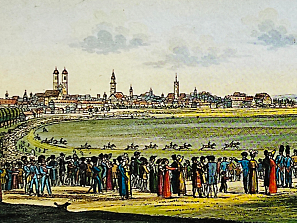
A 19th-century illustration depicts horse racing on the Theresienwiese.
Talk about a wedding gift! Oktoberfest originated as a celebration of the October 12, 1810, marriage between the crown prince of Bavaria, who would later be crowned King Louis I, and Princess Therese von Sachsen-Hildburghausen. Originally a five-day festival, the first Oktoberfest was known for its horse racing in fields that would be known as Theresienwiese, or Therese’s Green. Otherwise, the days included feasting and drinking. Forms of this celebration could be found all over Bavaria—people loved it so much, they decided to do it again the next year.
In 1811, a year later, the celebration included an agricultural state fair alongside the same sort of events. Food and drink booths would be introduced several years later, in 1818. For the first few decades, the main attraction of Oktoberfest continued to be horse racing and the agricultural shows—which still happen every four years. The festival was mainly a showcase of Bavarian culture, patriotism, and a prime opportunity for Munich’s guilds and shooting clubs to parade around the streets.
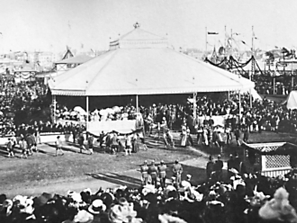
By 1895, Oktoberfest was well on its way to becoming the legendary party we know and love today.
The mid-19th century introduced beer gardens to the festival, which had been growing in popularity. With this introduction, the character of Oktoberfest changed completely, and a party-like atmosphere was born. As the years passed, the festival continued to evolve. By 1880, celebrations were able to persist long into the night due to the addition of electric lighting. Later, carousels and swings arrived, adding a carnival feel to the events, followed by performances of live music and traditional Bavarian Oompah music.
Finally, around the late 19th century, beer gardens expanded to beer halls. These temporary plywood structures had large seating capacities, interior balconies, and bandstands—and can be found at every turn of modern Oktoberfest.
An (Almost) Annual Tradition
Oktoberfest, since its start in 1811, has become a regular celebration, full of lively festivities. This said, it hasn’t been completely annual. Like many celebrations around the world, sometimes larger issues can get in the way:
Modern Oktoberfest
Nowadays, the festival is a huge production, and more than 6.5 million people attend. In 2023, a new attendance record was broken, and just over 7.2 million people, both local and from around the world, came to celebrate in Munich.
Though the festival is a celebration of Bavarian culture and tradition, the largest draw today is the beer. During the massive celebration in Munich, only beer produced within the city can be served. The six Munich breweries—Augustiner, Paulaner, Hacker-Pschorr, Spaten, Löwenbräu, and Hofbräu—certainly meet their sales numbers as the sole providers! In tents that resemble those created in the mid-19th century, these breweries sell in tented beer halls which can now seat thousands of people—with the record being 12,000 in one tent. The record for beer consumed at Oktoberfest is from 2011, where there were about 7,922,500 million liters of beer drank. These days, the typical Oktoberfest averages around 7.5 million liters.
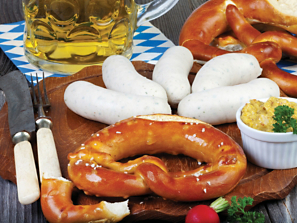
Nothing goes better with beer than traditional sausage and pretzels.
Besides beer, the modern-day Oktoberfest serves traditional German favorites, like bratwurst, soft pretzels, sauerkraut, and dessert strudels. According to tradition, each Oktoberfest kicks off with the Mayor of Munich tapping a keg before a cry of “O’zapft is!”—“It’s tapped!”—comes from the crowd. Events that resemble early Oktoberfests follow, like carnival rides, parades, and concerts, and are some of the most exciting parts of the celebration. And don’t forget your lederhosen or dirndl! Many people mill about in these traditional German clothes as they take in the grandeur of the celebration.
Oktoberfest Around the World
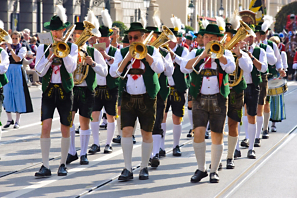
At any proper Oktoberfest, music is essential to the celebration.
As Oktoberfest has grown over the years, so has its global reach. Now, you can celebrate Oktoberfest far and wide, from Cincinnati to Brazil. Though no celebration can match the splendor of the original, they attract hundreds of thousands of people.
In the United States, the most well-known American Oktoberfest takes place in Cincinnati, Ohio. Called Oktoberfest Zinzinnati, this event takes place in just one weekend and is known as the second largest Oktoberfest celebration in the world—after Munich’s, of course. First held in 1976, Zinzinnati now draws over 800,000 people annually and has its own unique charm. This festival once set a world record for the largest Chicken Dance in 1994, with over 48,000 participants. Each year, there’s a bratwurst eating contest, and in 2022, the winner broke the world record. Zinzinnati is also known for its “Running of the Wieners,” in which dachshunds and dachshund mixes race in hot dog costumes.
In Santa Catarina, Brazil, you can find another of the world’s most-known Oktoberfests, entitled “Oktoberfest of Blumenau.” This festival attracts a crowd of about 700,000 and has its own traditions. At each celebration, a contest crowns a Queen of Oktoberfest from ten candidates, after evaluating them in different categories. One annual tradition is the National Competition of Tap Beer in Meter Drinkers. In this event, competitors drink one meter of beer in a tall yard glass without removing their mouth from the lip of the glass. The winner is the person who drinks the fastest, with no spilling or drooling involved.
Though each Oktoberfest is different, they all typically have beer, good food, Oompah music, and that good Bavarian gemütlichkeit!
Experience the traditions and charms of Bavaria at any time of year during The Great Rivers of Europe.
Get The Inside Scoop On...
Like what you see here? Receive weekly updates right in your inbox.
inside-scoopArticles In This Edition
